Several customers have asked about adding full message links in tweets and facebook posts. I am now in the process of developing a web application that will allow for links in the posted messages.
Initial tests look good. It does require a public facing IIS webserver with an associated domain name to process the embedded links.
Here is a sample post I made from my test twitter account. (http://www.twitter.com/kb4mdd)
NWS has issued a Area Forecast Discussion http://a.emwin.net/AFDBMX~1
In this example, I am using the domain name "a.emwin.net" to host the data feed.
Sunday, July 15, 2012


Monday, May 07, 2012
CAP Ingest
The next release of Weather Message will have the ability to ingest the National Weather Service CAP feed. CAP stands for the Common Alert Protocol. You can learn more about CAP from this wikipedia article.
The NWS publishes an Atom feed for each state that contains a list of active weather products. Each entry contains a link to the actual CAP formated XML. That XML is CAP compliant and contains specific information about the weather product.
At this time, this ingest engine is pull only. It has to poll the NWS servers for new products. In the future, they will be pushing this data and/or CAP compliant messages will appear on the regular NWS data streams.
Why do we need another ingest method? That is a good question. Many government agencies are now requiring software applications to be CAP compliant. This addition will allow Weather Message to be CAP compliant.
The NWS publishes an Atom feed for each state that contains a list of active weather products. Each entry contains a link to the actual CAP formated XML. That XML is CAP compliant and contains specific information about the weather product.
At this time, this ingest engine is pull only. It has to poll the NWS servers for new products. In the future, they will be pushing this data and/or CAP compliant messages will appear on the regular NWS data streams.
Why do we need another ingest method? That is a good question. Many government agencies are now requiring software applications to be CAP compliant. This addition will allow Weather Message to be CAP compliant.
Zephyrus WX-14 now in production
The Zephyrus WX-14 Next Generation EMWIN receiver is now in full production. Zephyrus is now accepting orders. You can contact them at 918-437-3333.
They are in the process of updating their website with information on the WX-14.
They are in the process of updating their website with information on the WX-14.
Monday, March 12, 2012
Thursday, December 29, 2011
The Zephyrus WX-14 EMWIN Receiver
Zephyrus Electronics is getting ready to release their new WX-14 EMWIN Receiver. I understand that they have some of these already installed for testing. This receiver is a hardware based receiver. It does not use a sound card. Users can interface to the receiver using a serial port, usb port, or ethernet connection (TCP/IP).
Here are some images of the receiver.


When Zephyrus is ready for customer orders, I will make another post.
One Weather Message user has one of these and is using the ethernet connection (TCP/IP). The Weather Message EMWIN ingest program supports TCP/IP connections to the receiver using the Software Demodulator ingest option. The Software Demodulator option will connect to the NOAA Software Demodulator or Zephyrus receiver using TCP/IP.
Here are some images of the receiver.


When Zephyrus is ready for customer orders, I will make another post.
One Weather Message user has one of these and is using the ethernet connection (TCP/IP). The Weather Message EMWIN ingest program supports TCP/IP connections to the receiver using the Software Demodulator ingest option. The Software Demodulator option will connect to the NOAA Software Demodulator or Zephyrus receiver using TCP/IP.
Tuesday, November 29, 2011

GOES-15 starts journey to replace GOES-11
GOES-15 has started its journey from storage to 135 degrees West. NWS HQ has confirmed that the satellite is transmitting the new EMWIN signal. Here is a schedule of events:
Transition Timeline:
Transition Timeline:
- August 22, 2011. GOES-15 began executing GOES-West frames (no Rapid (RSO), Super Rapid (SRSO) and the Full Disk (FD) frames) to accommodate advanced user testing of GOES-15 data.
- September 1, 2011 through October 15, 2011 is the GOES-15 Fall eclipse season for 2011.
- October 18, 2011 at 0321 UTC. GOES-15 will begin a westward drift from 89.5 degrees West to 135 degrees West at a rate ~ 0.78 degrees/day.
- December 1, 2011. A GOES-15 drift rate adjustment maneuver will be performed.
- December 6, 2011. As GOES-15 approaches 129 degrees West, the GOES-15 transition to GOES-West will occur. GOES-15 data will flow through GOES-11 communication links, thus, GOES-15 data becomes operational but is received through the GOES-11 downlink. In other words, the GOES-15 GVAR data are relayed through GOES-11. Users pointing to GOES-11 will start receiving GOES-15 data. Ancillary communication services (DCS/LRIT/EMWIN/SAR) will remain on GOES-11. Users do not re-point antennae. At this point GOES-15 data are considered operational, but should significant problems occur, GOES-11 data can be reestablished quickly.
- December 14, 2011. A GOES-15 stop maneuver will be performed. The GOES-11 signal is turned off and GOES-15 data are acquired directly from GOES-15. GOES-15 GVAR data will be relayed through GOES-15. Ancillary communication services (DCS/LRIT/EMWIN/SAR) will switch from GOES-11 to GOES-15.
- December 15, 2011. Pending successful arrival of GOES-15 at 135 degrees West, GOES-11 will perform de-orbit maneuvers, and GOES-11 will be decommissioned.
Thursday, October 13, 2011
GOES West Transition Date Confirmed
The GOES West Transition date has been confirmed. The transition is now scheduled for December 14, 2011. The following information was posted on the EMWIN website.
GOES West
GOES 15 is set to replace GOES 11 (West) on December 14, 2011. All EMWIN users should obtain EMWIN-N capable systems to continue to receive the satellite broadcasts. Legacy EMWIN Equipment must be upgraded.
What GOES West Users need to do
For GOES West (11) users with EMWIN-N capable systems the transition will be very simple, wait for the change to occur and then configure the software demodulator. Then toggle the switch on the intermediate frequency adapter to the “QPSK” setting. Processing of the EMWIN-N broadcast can then begin.
Users that have not upgraded their legacy EMWIN systems still have options. On or before December 14, 2011 legacy users need to re-point to GOES 12 at 60 degrees West. We recommend that these legacy users should try re-pointing to GOES 12 as soon as possible to determine if they will be able to acquire the signal from their location. Legacy users not able to receive the GOES 12 broadcast can continue to receive EMWIN with an internet connection through the EMWIN byteblaster network.
The transition could occur earlier due to premature failure of the GOES 11 satellite. All users need to migrate to EMWIN-N capable systems. Please see the vendor page on the EMWIN website.
GOES 12 is operating at 60 degrees West to help support the Caribbean and South America. The EMWIN-I 9.6 kbps signal was activated on GOES 12 on May 5, 2010 and will remain on until further notice. This service will eventually end, so it is strongly recommended that users transition as soon as possible.
Saturday, October 01, 2011
XMPP Support Added
Weather Message now supports the XMPP protocol. XMPP is implemented as a paging service. If you don't know what XMPP is, here is the information provided by the XMPP Standards Foundation.
This addition allows Weather Message to post alerts to chat groups. The posted messages can be in any of the supported Weather Message formats, short, selected or full.
The Extensible Messaging and Presence Protocol (XMPP) is an open technology for real-time communication, which powers a wide range of applications including instant messaging, presence, multi-party chat, voice and video calls, collaboration, lightweight middleware, content syndication, and generalized routing of XML data.XMPP is used by Google for Google talk. It is also used by the National Weather Service for their NWSChat service. Here is a list of XMPP clients listed on the Google website http://www.google.com/talk/otherclients.html
This addition allows Weather Message to post alerts to chat groups. The posted messages can be in any of the supported Weather Message formats, short, selected or full.
Sunday, September 25, 2011
Message Client Overhaul Part 2
Here is a picture of the latest changes to the message client. These change are in the latest 3.9 beta.


The main window now features a product list. A new request tab appears that works like the existing request window. This consolidates several of the features into the main window.
Friday, September 23, 2011
Weather Message Software LLC
We are now Weather Message Software LLC. Nothing has changed except the structure of the business. I will be posting additional information as we position the company for the future.
Thursday, September 22, 2011
GOES-15 to replace GOES-11 (West) in December 2011
If you are using GOES-West to receive the EMWIN datastream, this is a reminder that the GOES-West transition is planned for December 2011. Based on information presented during the 2011 Satellite Direct Readout Conference, GOES-15 will be taken out of storage before the fall eclipse season for yearly inclination maneuver and imager testing. It will start drifting to 135 degrees west in October 2011.
If you have not upgraded your receiver for the EMWIN-N signal, now is the time to start planning.
If you have not upgraded your receiver for the EMWIN-N signal, now is the time to start planning.
Monday, September 05, 2011
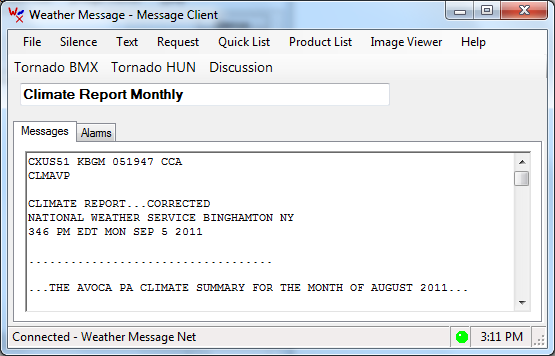
Message Client Overhaul
I have started the process of overhauling the Message Client. The main user interface will be receiving an update to provide more features.
The first change gives users the ability to associate function keys with the Quick List products. The second change allows selected Quick List items to be turned into Quick Buttons. The Quick Buttons appear under the menu.
The following screen demonstrates the change.

The first change gives users the ability to associate function keys with the Quick List products. The second change allows selected Quick List items to be turned into Quick Buttons. The Quick Buttons appear under the menu.
The following screen demonstrates the change.
Saturday, August 27, 2011
Weather Message Byte Blaster Server now on port 2211
On January 30, 2010, I blogged about port number 2211 being assigned to EMWIN. See EMWIN Port 2211 for more information. Today I moved the Weather Message Byte Blaster server to port 2211. There are now a number of servers using this as the standard Byte Blaster port.
I updated the Byte Blaster Server to default to port 2211 for new installs. If you run a Byte Blaster server, you should be able to safely move it to port 2211.
The NWS servers will continue to use port 1000. This will allow users behind firewalls with port 1000 open to continue to operate properly.
Users that had to open port 1000 should consider opening port 2211 also.
I updated the Byte Blaster Server to default to port 2211 for new installs. If you run a Byte Blaster server, you should be able to safely move it to port 2211.
The NWS servers will continue to use port 1000. This will allow users behind firewalls with port 1000 open to continue to operate properly.
Users that had to open port 1000 should consider opening port 2211 also.
Thursday, August 04, 2011
WeatherMessage.net domain
After alot of discussion, we have purchased the WeatherMessage.net domain. This domain will work just like the wxmesg.com domain. Over the years, many people have asked what WxMesg.com means. In order to reduce confusion, we decided to use a domain name that simply identifies the company and our product.
The new domain, although longer, will be easier for potential customers to understand and type. We will start migrating to the new domain over the coming months. The original WxMesg.com domain will remain in place.
The new domain, although longer, will be easier for potential customers to understand and type. We will start migrating to the new domain over the coming months. The original WxMesg.com domain will remain in place.
Monday, July 04, 2011
Weather Message 3.8 Released
Weather Message V3.8 has been released. You can download the update at http://www.wxmesg.com/downloadsnet.htm. For information on what has changed in this release, please read the release notes.
Note: Version 3.8 requires the Microsoft.Net Framework 3.5. Because of this requirement, version 3.8 will not run on Windows 2000 or older operating systems.
There are over 50 changes in this release. Here are some highlights.
There are over 50 changes in this release. Here are some highlights.
- Will now use the Microsoft Framework 4.0, if installed.
- Updated support for Facebook and Twitter.
- New short message variables.
- Support for FTPS and SFTP.
- WxMap now supports a dynamic map legend.
- WxMap now has an option to use the NWS product colors.
- WxMap now has an option to zoom to a county when reading a text product.
- Retired the Active-X version of WxMap. WxMapNet replaces WxMap.
- WxMap will now run as a 64 bit application.
Thanks for all of your suggestions, bug reports and assistance with the software. Work will begin on version 3.9 right away. Watch the beta page for updates.
Suggestions for 3.9
Suggestions for 3.9
- I have over 50 pending feature enhancements. If you want to see a new feature, please send us an email.
WxDataSave, WxLocal and the Retransmission applications have been respectively released along with Weather Message 3.8. If you are using any of these applications, they must be upgraded at the same time you upgrade Weather Message.
Note: I recommend that users download and install the full Microsoft.Net Framework 4.0. The Framework has two editions, Client and Extended. You can use this link to download both editions - http://www.microsoft.com/download/en/details.aspx?id=17851
Note: I have a large number of pending requests. I will begin to address these over the coming months.
Note: I am still working on a new Weather Message website. The revised website will ultimately allow users to login and obtain their registration codes.
Saturday, July 02, 2011
NOAA to take over the Weather Wire Service
One of my users sent me a letter he received from CSC. CSC provides the Weather Wire service. Here is an excerpt from the letter.
Weather Message users who use this service need to follow this closely.
Subject: Discontinue of Weather Wire Service
Dear Weather Wire Subscriber:
Our records indicate you receive the Commercial Weather Wire Service via C-Band or Internet. CSC has provided these services for the past twenty (20) plus years to our customers. It is with great regret CSC needs to inform you that NOAA Weather Service has decided not to continue the Weather Wire Program with CSC. As of now we do know that the Weather Wire Service will be provided directly from NOAA.
At this time, CSC doesn't have any particulars or contact information to disclose. CSC will continue to provide the Weather Wire Service until first quarter of 2012. As soon as we find out more information, we will inform all of our Commercial Weather Wire Customers whom the POC is and how to receive the information on the Service NOAA will provide.
We are sorry for any inconvenience this may cause our customers.
Saturday, May 21, 2011
Weather Message 3.8 Beta 9
I have posted Weather Message version 3.8 beta 9 to the beta website. It contains a fix that makes Twitter authorization work. Twitter had changed their website and it had stopped working. It also includes a couple of enhancements.
Thursday, May 19, 2011
New Email Server
My office now has a new in-house email server. I have moved Weather Message's email to that server. If you experience a problem sending me email, please post a message to the Weather Message Yahoo group.
Wednesday, May 11, 2011
Novra S300 Firmware Update
Novra has released a firmware update for the S300 receiver. The release notes list the following change:
S300 V2R7 Release NotesThe firmware update can be found at this link http://www.novra.com/Website/Novra_Support.html Scroll down to the bottom of the page.
- includes firmware modifications to improve NOAA data reception.
Subscribe to:
Comments (Atom)


 times.