Saturday, November 22, 2014
MapQuest OpenStreetMaps - Implemented in WxMap
I have completed the implementation of OpenStreetMaps in WxMap. After getting the projections corrected, the map looks very good.


Sunday, November 16, 2014
MapQuest OpenStreet Maps
I have been testing MapQuest's OpenStreet Maps in WxMap. Here is a preview. It appears blurry or distorted.


I am working to see if I can make these clearer. These maps are free and are served over the internet.
I am working to see if I can make these clearer. These maps are free and are served over the internet.
Monday, October 20, 2014
EMWIN Dual Internet Ingest
The next version of Weather Message's EMWIN ingest engine will have the ability to dual ingest the Internet data stream.

This feature is designed for users that do not have a satellite dish and want to minimize the potential loss of weather products. For users with critical applications, we always recommend dual ingesting from a satellite feed along with the EMWIN Internet feed.
Ingesting EMWIN data from two Internet feeds can minimize data loss. It however will not help when your local Internet connection goes down. There are times when an EMWIN server may go down due to normal rebooting, rebooting for windows updates, loss of Internet connectivity to that server, disconnection due to Internet connection speed, packet loss, router reboots, or a number of other hard to explain reasons.
When a connection to an EMWIN server is lost, there is a short period of time of data loss. This occurs as the software is attempting to connect to the next available EMWIN Server.
This feature is now being tested. It will be sold as an additional ingest engine. More information and pricing will be posted on our website when this feature is available for general use.
Tuesday, July 22, 2014
Alertus Integration
We have completed the changes to integrate Weather Message with Alertus . This allows users of the Alertus service to have weather notifications sent to their users.
Friday, March 21, 2014
IRIS Integration
We have completed the changes to integrate Weather Message with IRIS. This allows users of the IRIS service to have weather notifications sent to their users setup in the IRIS system.
Wednesday, February 19, 2014
RAVE Integration
We have completed the changes to integrate Weather Message with RAVE. This allows users of the RAVE service to have weather notifications sent to their users setup in the RAVE system.
Friday, January 24, 2014
Emailing Log Files
Weather Message Version 4.1 will have the ability to email you a user defined list of log files. This will help users that want to review their log files on a daily basis. You can specify the email address that will receive the log files and the time that they should be sent.
An option is selectable by log file to check it for the work "Error". If this option is enabled, the log file will only be sent when it find the word "Error". This may be helpful to those users that post to Facebook and Twitter.
An option is selectable by log file to check it for the work "Error". If this option is enabled, the log file will only be sent when it find the word "Error". This may be helpful to those users that post to Facebook and Twitter.
Saturday, January 11, 2014
Weather Message 4.0 Released
Weather Message V4.0 has been released. You can download the update at http://www.weathermessage.com/Downloads/WeatherMessage.aspx. For information on what has changed in this release, please read the release notes.
Note:
Version 4.0 requires the Microsoft .Net Framework 4.0. Because of this
requirement, version 4.0 will not run on Windows 2000 or older
operating systems.
There are over 57 changes in this release. Here are some highlights.
There are over 57 changes in this release. Here are some highlights.
- Several Email and Paging enhancements, including the addition of new short message variables.
- Updated County and Zone Files.
- Updated map layers - this is a separate download.
- FTP downloads from the NWS server using your assigned user name and password.
- Auditing of changes
- WxPort now supports the POLAR Sat channel.
WxDataSave,
WxLocal and the Retransmission applications have been respectively
released along with Weather Message 4.0. If you are using any of these
applications, they must be upgraded at the same time you upgrade Weather
Message.
Thanks
for all of your suggestions, bug reports and assistance with the
software. Work will begin on version 4.1 right away. Watch the beta
page for updates.
Version 4 is a Major Upgrade
This is a major update and requires a new registration code. Customers who purchased Weather Message on or after 8/1/2012 are entitled to a free upgrade to version 4.0.
Users who are running a 4.0 beta can continue to use the 4.0 beta. The 4.0 beta releases used the 3.9 registration codes. If you install the 4.0 public release, your system will be placed in evaluation mode. You will have 30 days to purchase an upgrade from 3.x to 4.0.
Our policy is to provide free same version updates. Customers who purchased Weather Message 3.0 in 2006 have received free updates for the past 7 years.
The cost of to upgrade Weather Message 3.x to 4.0 is $30.25.
Monday, November 04, 2013
External USB Sound Card for the Werner Labs Receiver
The Behringer UCA202 Audio Interface can be used with the Werner Labs Receiver. This is an external USB Sound Card. It eliminates the need to use the internal sound card for processing the receiver's data stream.

One of my customers is using this interface with a virtual machine.
One of my customers is using this interface with a virtual machine.
Thursday, August 29, 2013
New Weather Wire Feed Confirmed
The NOVRA S300N receiver settings, for Weather Wire, in the previous blog post have been confirmed. I was able to receive data from the new Weather Wire feed tonight.
I made some modifications to WxPort (our NOAA Port ingest program) to receive the data stream. The stream is in standard SBN format, so I did not have to develop a new ingest routine.
The following picture shows the stream being received and processed by Weather Message.
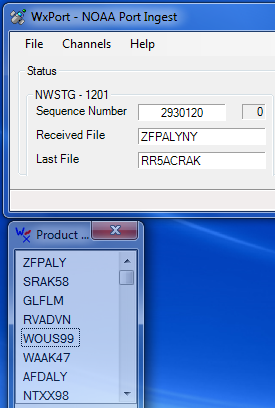
I plan to update the existing WxWW2000 ingest program to support this feed.
I made some modifications to WxPort (our NOAA Port ingest program) to receive the data stream. The stream is in standard SBN format, so I did not have to develop a new ingest routine.
The following picture shows the stream being received and processed by Weather Message.
I plan to update the existing WxWW2000 ingest program to support this feed.
Tuesday, August 27, 2013
Novra Receiver Settings
I have been trying to receive the new WeatherWire stream using my Novra S300 receiver. I thought it was as simple as adding PID 201 to the Novra receiver. After further research I found that some of the other receiver settings would have to be modified.
The following summarizes the settings for Weather Wire and NOAA Port.
Based on this information, it does not appear that you can receive NOAAPort and WeatherWire from the same receiver at the same time.
The following summarizes the settings for Weather Wire and NOAA Port.
Setting
|
NOAA Port
|
Weather Wire
|
Frequency
|
1154
|
1154
|
Modulation
|
DVBS2
|
DVBS2
|
Coding
|
2/3 8 PSK
|
1/3 QPSK
|
Symbol Rate
|
15.120
|
15.120
|
ISI
|
13
|
2
|
PID
|
101
102 103 104 105 |
201
|
Based on this information, it does not appear that you can receive NOAAPort and WeatherWire from the same receiver at the same time.
Wednesday, August 21, 2013
New Weather Wire Service Coming this Fall
The National Weather Service issued a Service Change Notice that outlines the new Weather Wire Service. It appears that Weather Wire will be on the same satellite as NOAAPort. It will use the same receiver as NOAAPort and share the transponder. The information that has been posted indicates that it will use PID 201.
Here is a picture of the Novra S300 receiver used for NOAAPort.

I am interested to see what data will be on the Weather Wire channel. The NOAAPort stream already contains more data than the current Weather Wire feed. The website indicates that they will be providing an internet feed based on XMPP.
It may be possible to modify the WxPort (NOAAPort) ingest engine to receive the data from the satellite. I will know more after seeing the data stream. The WW2000 (Weather Wire) ingest will have to be rewritten to receive the XMPP data stream.
Here is a picture of the Novra S300 receiver used for NOAAPort.
I am interested to see what data will be on the Weather Wire channel. The NOAAPort stream already contains more data than the current Weather Wire feed. The website indicates that they will be providing an internet feed based on XMPP.
It may be possible to modify the WxPort (NOAAPort) ingest engine to receive the data from the satellite. I will know more after seeing the data stream. The WW2000 (Weather Wire) ingest will have to be rewritten to receive the XMPP data stream.
Service Change Notice 13-52
National Weather Service Headquarters Washington DC
722 AM EDT Tue Aug 20 2013
To: Subscribers:
-NOAA Weather Wire Service
Other NWS Partners, Users and Employees
From: Craig Hodan
Chief, NWS Dissemination Systems Branch
Subject: New NOAA Weather Wire Service (NWWS) During 2014
NWS is continuing the upgrade of NWWS to disseminate weather products to the public. A new NWWS will be commissioned during 2014. The new NWWS will operate concurrently with the present NWWS system until the NWWS system contract ends March 2014, at the earliest. For the latest news and information about this change, please consult the Weather Wire website at:
http://www.nws.noaa.gov/nwws/news.html (Corrected Link)
The new system will allow C-band satellite users to continue to use outdoor antennas they have in place, which will not require re-pointing but will require a new satellite receiver, new Low Noise Block Converter (LNB), and new or modified weather data processing/display software. Internet (Open Interface) users will need the new or modified processing/display software.
The current NWWS system, operated under contract with Computer Sciences Corporation (CSC), will continue to operate into 2014. CSC may or may not continue Weather Wire satellite and open-interface services after government contract termination.
Updates will be posted on the NWWS website as it become available. For more information please contact:
Gregory Zwicker, NWWS Program Manager
Operations Division
NWS Office of Operational Systems
Silver Spring, MD 20910
Gregory.Zwicker@noaa.gov
National Service Change Notices are online at:
http://www.weather.gov/os/notif.htm
$$
Monday, August 12, 2013
Radar Layer in WxMap
I had some time tonight to test loading a radar layer in WxMap. I knew that the GIS engine would support graphic layers, I just have not had time to test the capability.
Here is a snapshot of the test program.

Here is a snapshot of the test program.

This shows the KMXX radar image overlaying West Alabama.
Thursday, July 11, 2013
GOES 12 Decommissioning to Occur August 16, 2013
GOES-12 is scheduled to be decommissioned on August 16,
2013.
GOES-12 was launched on July 23, 2001, and it has
supported South America at 600W since May 2010. The National Environmental
Satellite, Data, and Information Service (NESDIS) announced the decommissioning
on July 9, 2013.
The decommissioning will end the broadcast of the EMWIN-I
legacy data stream. This broadcast was
put in place to assist users in the transition to EMWIN-N on the operational
GOES East and West satellites and facilitate manufacturer testing. Any
remaining legacy users should migrate to EMWIN-N capable systems and use GOES
East or West.
GOES 12 EMWIN-I users can also continue to receive EMWIN
with an Internet connection through the EMWIN ByteBlaster Network if unable to
upgrade to newer equipment.
For the latest information on the GOES 12 decommissioning
and for a list of vendors that currently provide EMWIN-N capable systems,
please go to:
Tuesday, June 04, 2013
GOES 13 is Broadcasting EMWIN Data
GOES 13 is now broadcasting EMWIN data. Here is the latest update.
GOES-13, at 75 degrees West, will return to GOES-East operations on Thursday, June 6, 2013, at approximately 1534 -1545 UTC (first image at 1545 UTC). Derived products from GOES-13 will begin immediately following the switchover.
All GOES direct readout services (DCS, LRIT, EMWIN, etc.) except SAR were switched over to GOES-13 today, June 4, 2013. Specifically, GOES DCS services were switched back to GOES-13 on June 4, 2013, at 1530 UTC.
GOES DCS has no issues and there has been no outage to the communications packages.
Wednesday, May 29, 2013
GOES 13 Status
I know many of you are trying to decide whether to reposition your dish to GOES-14. Here is the latest status on GOES-13.
GOES-13 remains out of service with no estimate on return to operations at this time. It was successfully brought out of storage mode for testing last night, and will be monitored for 24 hours.It appears that there is still some life in GOES-13. Hopefully it can be brought back on-line.
Thursday, May 23, 2013
GOES 14 takes over for GOES 13
From the EMWIN Team:
GOES-14 at 105 degrees W now broadcasting EMWIN
EMWIN Users:
To help mitigate the GOES-13 outage, GOES-14 is now broadcasting EMWIN data. It is located at 105 degrees West.
GOES-14 It will not be drifted east. Engineering at NESDIS will continue to investigate the anomaly. Meanwhile, GOES-13 will remain in storage mode.
Users now have the option to re-point to GOES-14 or remain in back up mode with antennas still pointed at GOES-13.
EMWIN team
GOES 13 Outage
From the EMWIN Team:
You will find details on the problem on this web page.
http://www.ssd.noaa.gov/PS/SATS/bulletins.html
EMWIN Users
Be advised that there is an anomaly on the GOES 13 satellite that affects systems on the spacecraft including the EMWIN broadcast. NESDIS engineering is working on the problem. Please switch to the Byteblaster back up or point your antenna to GOES 14.
EMWIN team
You will find details on the problem on this web page.
http://www.ssd.noaa.gov/PS/SATS/bulletins.html
Saturday, May 18, 2013
EMWIN Logon Changes Tested
I participated in the EMWIN Logon changes test this week. Starting June 10, 2013, the National Weather Service will require all EMWIN FTP users to use an assigned user name and password to access the FTP server. If you do not use the FTP method to access the server, no changes are required.
If you use the EMWIN FTP server, you should send an email to Rob Wagner, EMWIN Team, Office of Operational Systems, robert.wagner@noaa.gov with your static or dynamic IP address. You will be assigned a user name and password to access the FTP server.
In a previous blog post I announced that users would be required to use a static IP address. The NWS will now filter dynamic IP users on the first three octets of their IP address. This should not be a problem for most dynamic IP users. (The first three octets are highlighted in the following IP address: 192.168.10.25)
I noticed that my Verizon 4G wireless connection does change that third octet on occasion. Because of this, I have sent multiple IP addresses for my registration.
Weather Message 4.0 contains changes that allows users to enter their assigned user name and password.
Note: To my knowledge a small number of Weather Message users use the FTP ingest option.
Weather Message 3.9.3 Released
Weather Message version 3.9.3 was released today. This version of Weather Message contains changes to address problems with authorizing Facebook and Twitter. If you have already authorized these services, you do not need this update.
These changes have already been included in the current 4.0 beta.
These changes have already been included in the current 4.0 beta.
Subscribe to:
Posts (Atom)